Sometimes, the most important person you need to get to know is yourself.
When was the last time you asked yourself how you are really doing?
Not the quick “I’m fine” you give when someone asks. Not whether you have finished your to-do list, replied to your messages, or made progress toward your goals.
I mean, when was the last time you sat with yourself and wondered – Am I happy with the life I am creating? Do I know what I actually want? Have I changed without even noticing?

It’s surprisingly easy to become a stranger to yourself.
You grow up, take on responsibilities, build routines, make plans, and slowly get used to being the person everyone expects you to be. Somewhere between managing everyday life and trying to figure out the future, you forget to check in with the person living it.
And sometimes, you don’t even realize how disconnected you have become until something feels off.
Maybe you are achieving things that once excited you, but they don’t feel as fulfilling anymore. Maybe you are constantly comparing yourself to others. Or perhaps you are simply at a point in life where you are wondering who you are beyond your work, relationships, and responsibilities.
That’s where self-discovery journaling can be incredibly valuable.
You don’t need an expensive journal, a perfect morning routine, or beautifully written pages. You just need a little honesty and the willingness to ask yourself questions you might have been avoiding.
These 15 self-discovery journal prompts will help you explore your personality, understand your emotions, recognize your strengths, reflect on your goals, and reconnect with what truly matters to you.
Some questions will be easy to answer. Others might make you think a little longer.
And that is exactly the point.
*This post may contain affiliate links. If you make a purchase through one of these links, I may earn a small commission at no extra cost to you.
Let’s begin…..
What Is Self-Discovery Journaling?
Self-discovery journaling is the practice of writing about your thoughts, feelings, experiences, beliefs, and desires to understand yourself better.
Unlike keeping a diary that simply records what happened during your day, a self-discovery journal encourages you to explore why you think, feel, and behave the way you do.
For example, instead of writing:
“Today was exhausting.”
You might ask yourself:
“What made today feel so draining? Was it the amount of work I had, or was I spending my energy on things that don’t really matter to me?”
See the difference?
One records an experience. The other helps you understand it.
That’s why journal prompts for self-reflection can be especially useful when you feel confused, overwhelmed, stuck in a routine, or unsure about your next chapter.
You begin noticing patterns you might otherwise overlook like what makes you happy, what drains your energy, what triggers your insecurities, and which dreams still matter to you.
Self-awareness doesn’t arrive all at once. Sometimes, it begins with one question and an answer you weren’t expecting.
Save to Pinterest
Why Self-Discovery Matters More Than You Think
We spend so much time learning about other people.
We remember their preferences, notice their moods, understand their habits, and try to figure out what makes them happy.
But how much attention do we give ourselves?
Knowing yourself goes beyond being able to describe your personality in a few words.
It means recognizing your boundaries before you are completely exhausted. Understanding what you value before making a major decision. Knowing the difference between something you genuinely want and something you have been taught to want.
And perhaps most importantly, it means giving yourself permission to change.
The things that made you happy five years ago might not excite you today. Your priorities may have shifted. You might have outgrown certain habits, friendships, or expectations.
That doesn’t necessarily mean something has gone wrong. It might simply mean you are growing.
And as you grow, you may begin noticing parts of your life that no longer feel quite right. Maybe your priorities have changed, or you have started wanting something different for yourself. Recognizing those feelings is important, but figuring out what to do with them can be another challenge altogether.
If you are ready to explore what positive change could look like, these 20 effective ways to improve yourself and build a life you feel good about offer some thoughtful ideas to get started.
But meaningful change begins with understanding yourself first. Before deciding what to improve, you need to know what truly matters to you.
These deep journal prompts for self-discovery are an opportunity to notice that growth instead of moving through life on autopilot.
And the best part? You don’t need to have all the answers before you begin. You only need to be willing to explore the questions.
How to Use These 15 Self-Discovery Journal Prompts
Before you begin, forget the idea that journaling has to look a certain way.
You don’t need to answer all 15 questions in one sitting. In fact, I’d encourage you not to rush.
Think about those little pockets of free time throughout your day. The ten minutes before bed, a quiet afternoon, or the moments when you instinctively reach for your phone without even thinking about it. Instead of letting those moments disappear into endless scrolling, why not use a few of them to reconnect with yourself?
Journaling is one of those small activities that can make your free time feel more meaningful. And if you are looking for more inspiration, I have shared 30 better things to do instead of scrolling on your phone that can help you enjoy those screen-free moments.
To begin, simply choose one question that catches your attention and spend 10–15 minutes exploring it. Write whatever comes to mind, even if your thoughts feel messy or contradictory.
You can start with:
“I don’t really know the answer to this, but…”
Sometimes, that’s where the most interesting writing begins.
If you are completely new to journaling, start with a blank notebook and a single question. There’s no need to wait until you have the perfect supplies or a beautifully organized journal.
Still, there’s something comforting about having a notebook that feels like your own little space. One where you can write freely, revisit old thoughts, and slowly fill the pages with pieces of your everyday life.
If you love the simplicity of a classic notebook, the LEUCHTTURM1917 A5 Hardcover Notebook is worth exploring. Its open-page format lets you make the journal entirely your own, whether you are answering a single prompt or writing about everything on your mind.
And once you have found a place for your thoughts, the next challenge is often figuring out how to put them into words.
And if you are sitting there with your notebook open, wondering how to turn those scattered thoughts into actual words, you are certainly not alone.
Getting started can feel surprisingly awkward, even when you have plenty on your mind. That’s why I have put together a simple guide on how to start journaling (even if you don’t know what to write), to help you ease into the habit without overthinking every sentence.
One more thing to remember is that, your journal is not a performance.
You don’t have to sound wise, optimistic, grateful, or emotionally mature on every page. You can be confused. You can change your mind halfway through a sentence. You can admit something you have never said out loud.
The goal isn’t to write the perfect answer. It’s to write an honest one.
And the beautiful thing about asking yourself the right questions is that you never quite know what you’ll discover.
A question about confidence might remind you of a version of yourself you haven’t seen in a while. A question about your future might make you reconsider a goal you have been chasing for years. Even something as simple as describing your life in one word can reveal feelings you’ve been too busy to notice.
That’s what makes self-discovery so interesting. Sometimes, the questions that appear the simplest are the ones that stay with us the longest.
So, whether you are beginning your first self-reflection journal or returning to journaling after a long break, consider these questions an invitation to spend a little time with yourself.
Find a comfortable corner, grab your favorite notebook, and give yourself permission to be curious about the person you are becoming.
You might be surprised by what you have to say.
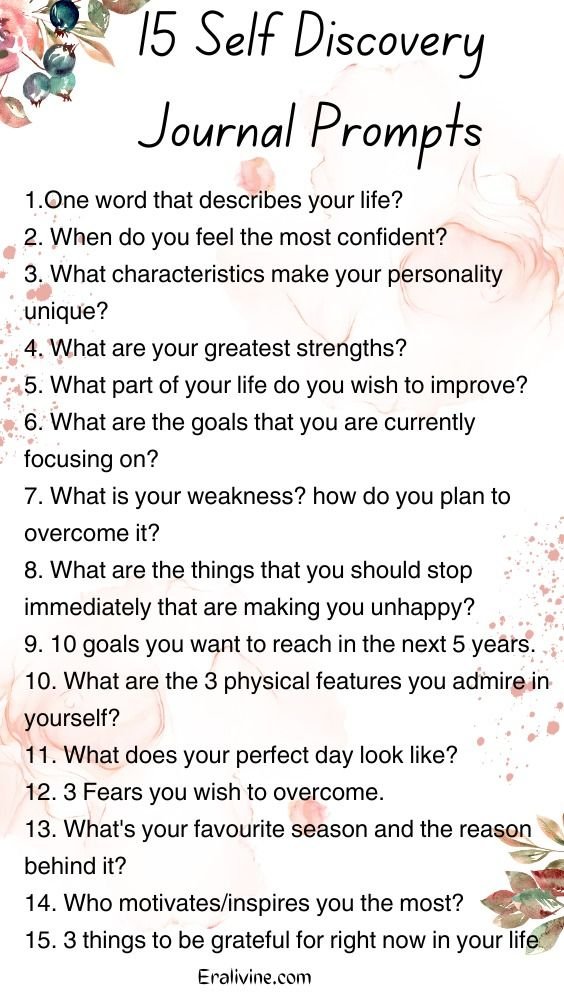
15 Self-Discovery Journal Prompts to Get to Know Yourself Better
- One word that describes your life?
- When do you feel the most confident?
- What characteristics make your personality unique?
- What are your greatest strengths?
- What part of your life do you wish to improve?
- What are the goals that you are currently focusing on?
- What is your weakness? How do you plan to overcome it?
- What are the things that you should stop immediately that are making you unhappy?
- 10 goals you want to reach in the next 5 years.
- What are the 3 physical features you admire in yourself?
- What does your perfect day look like?
- 3 fears you wish to overcome.
- What’s your favourite season and the reason behind it?
- Who motivates/inspires you the most?
- 3 things to be grateful for right now in your life.
Somewhere between the first question and the last, you may have noticed something interesting.
Perhaps one question brought back a memory you hadn’t thought about in years. Maybe another made you pause because you weren’t quite sure how to answer it. Or perhaps you found yourself writing about something completely different from what the question originally asked.
That’s the beauty of journaling. Your thoughts don’t always follow a straight line, and they don’t have to.
You may even find that some of your answers contradict each other. You might want adventure but crave stability. You might dream of achieving big things while also wishing life would slow down a little.
Those feelings can exist together.
And you don’t have to resolve every contradiction today.
What matters is that you have given yourself a chance to notice them.
But there’s one more thing worth doing before you put your journal away.
Because writing your thoughts down is only part of the experience. Taking a moment to understand what those thoughts might be telling you is where self-reflection becomes especially meaningful.
What to Do After Answering These Self-Reflection Questions
Once you have worked through these prompts, don’t immediately close your journal and forget about them.
Take a little time to read your answers.
Not to judge them or correct them, but to notice what keeps appearing.
You might discover that you repeatedly mention wanting more freedom, creativity, rest, or meaningful connection.
You might notice that certain fears show up in different areas of your life.
Or perhaps you’ll realize that the goals you have been chasing don’t quite match the kind of ordinary day you want to live.
That gap between what we say matters and how we actually spend our time can be revealing.
And once you begin noticing these patterns, you might find yourself wanting to explore them a little further. Sometimes, a question opens the door to another question, and suddenly there’s much more to reflect on than you expected.
If you enjoy having thoughtful questions to guide your writing, a guided self-discovery journal can be a lovely companion. Look for one that encourages you to explore your values, emotions, personal strengths, and the things that make you feel most like yourself.
But you don’t need to begin an entirely new journal to understand what you have already written. Your own answers can offer plenty to reflect on, especially when you take the time to revisit them.
Try this simple reflection exercise:
- First, underline three things that surprised you.
Maybe you wrote something you hadn’t consciously acknowledged before.
- Circle anything that appeared more than once.
Repeated feelings, desires, and concerns may be worth exploring further.
- Finally, finish this sentence –
“After answering these questions, one thing I want to do differently is…”
Keep your answer small enough to act on. You don’t need to redesign your entire life because of one journaling session.
A meaningful change might be making more time for a hobby, setting one boundary, reconnecting with a friend, or giving yourself permission to rest without guilt.
And sometimes, once you begin noticing what needs your attention, you might feel tempted to change everything at once. Your routines, your habits, your priorities suddenly, there’s a whole list of things you want to work on.
But personal growth doesn’t have to become another overwhelming responsibility.
If you are wondering where to begin, I have shared 20 simple ways to get your life together without feeling overwhelmed that can help you make those everyday changes at a pace that feels manageable.
Because the real value of personal growth journal prompts isn’t how many pages you fill.
It’s whether you begin paying closer attention to yourself and allowing what you have discovered to shape the way you live.
And if you have enjoyed spending this time reflecting, there’s a lovely way to turn it into a small ritual rather than a one-time exercise.
Turn These Prompts Into a 15-Day Self-Discovery Journal Challenge
If you enjoy having a little structure, here’s an idea.
Turn these questions into your own 15-day journaling challenge for self-discovery.
Answer one question each day for the next 15 days. You could write in the morning with your coffee, during a quiet afternoon, or just before bed. There’s no need to make it complicated.
Give yourself ten minutes, write the question at the top of the page, and follow your thoughts wherever they lead.
Some days, you might write two sentences. Other days, you might fill three pages. Both count.
And when you reach Day 15, go back to your first entry. Notice how your perspective may have shifted.
You might find that a question you initially considered simple revealed something you hadn’t expected.
You could also save this article and return to the same prompts three or six months later. Your answers may be different because you are different.
That’s one of the loveliest things about keeping a self-discovery journal, it becomes a record not only of what you thought, but of how you have grown.
And once you have spent some time exploring who you are, you might feel inspired to look a little more closely at the good things already present in your life. After all, understanding yourself isn’t only about recognizing what needs to change. It’s also about appreciating the people, experiences, and everyday moments that make your life meaningful.
That’s where gratitude journaling can become a lovely addition to your routine. If you’d like to explore it further, my 50 gratitude journal prompts for a positive lifestyle offer a fresh set of questions to help you notice and appreciate those little things.
If gratitude journaling becomes something you look forward to, you might enjoy giving it a little space of its own. A dedicated journal can make it easier to return to the practice, even on days when you only have a few minutes to spare.
The Five Minute Journal by Intelligent Change is one option to explore if you prefer a structured approach to daily gratitude and reflection. It offers a different experience from an open notebook, which can be appealing when you’re looking for a little guidance rather than another blank page.
Whether you enjoy following prompts or letting your thoughts flow freely, the important thing is finding a journaling routine that feels comfortable enough to return to.
And as you continue exploring journaling, you might still wonder whether there’s a right way to do it, how often you should write, or what to do when your mind goes completely blank.
The good news is that journaling is far more flexible than most people think.
Let’s answer a few of those common questions.
So to Conclude: Getting to Know Yourself Is a Lifelong Conversation
Here’s something I hope you remember after reading this:
You don’t have to have yourself completely figured out.
You don’t need a perfectly defined purpose, an impressive five-year plan, or an answer to every difficult question.
You are allowed to be a work in progress. You are allowed to discover that something you once wanted no longer makes you happy.
You are allowed to change your mind, explore new interests, outgrow old expectations, and become someone your younger self wouldn’t have imagined.
That’s not a failure to know yourself. It’s part of getting to know yourself.
And sometimes, the most powerful thing you can do is spend a few quiet minutes asking how you are really feeling, what you truly want, and whether the life you are creating still feels like your own.
So, pick up your journal. Choose one question.
And see where your thoughts take you.
Now Your turn! Which of these 15 self-discovery journal prompts made you stop and think? Share your favorite in the comments. I’d love to know which question resonated with you.
If you Loved these prompts? Save this post to your Pinterest.
You Might Also Like:
And if you are looking for more inspiration, explore more journaling ideas, mindful living tips, and personal growth inspiration here on Eralivine.
Here’s to knowing yourself a little better, one honest page at a time.