Goal setting isn’t about following a set of strict rules, creating the perfect plan, or pushing yourself to achieve everything as quickly as possible.
It’s about knowing what you want, breaking your goals into manageable steps, and staying flexible as you work towards them.
We all set goals at some point in our lives. Maybe you want to improve your health, become more productive, save money, learn something new, or simply build better habits.

And with another New Year approaching, you might already be thinking about what you want to do differently in 2027.
But have you ever noticed how easy it is to set a goal and how difficult it can sometimes feel to follow through?
You begin with excitement, make a plan, and promise yourself that this time things will be different. Then life gets busy, your motivation fades, or something doesn’t go quite as expected.
Before you know it, you are wondering whether you are simply bad at achieving goals.
But what if the problem isn’t you or your goals? What if it’s the way you have been taught to think about goal setting?
There are quite a few common goal-setting myths that can make the whole process feel more complicated and overwhelming than it needs to be.
And sometimes, without even realizing it, we allow these beliefs to hold us back.
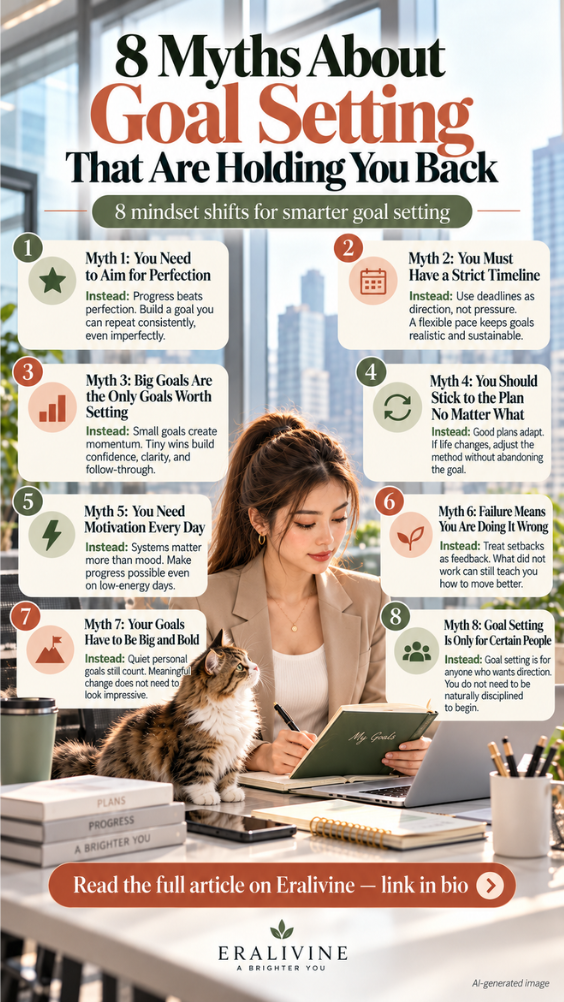
So, let’s talk about 8 myths about goal setting, why they aren’t always helpful, and what you can do instead to set realistic goals and make meaningful progress.
Save to Pinterest
*This post may contain affiliate links.
Let’s begin…..
Myth 1: You Need to Aim for Perfection
We often have this idea that once we set a goal, everything needs to go exactly as planned.
We want the perfect routine, the perfect schedule, and the perfect results. But the reality is, life doesn’t work that way, does it?
Some days will go smoothly. Other days, you’ll get distracted, feel tired, or have responsibilities that need your attention. And that’s normal.
One of the biggest goal-setting mistakes is believing that if you can’t do something perfectly, there’s no point in doing it at all.
But making progress doesn’t mean getting everything right.
It means continuing to take small steps, even when things aren’t going according to plan.
What to do instead: Focus on progress rather than perfection. If you miss a day or fall behind, don’t treat it as a reason to give up. Simply pick up where you left off.
Every little step counts, even the ones that don’t look particularly impressive.
Myth 2: You Must Have a Strict Timeline
Setting a timeline for your goals can be helpful. It gives you something to work towards and helps you stay focused. But being too strict about that timeline can create unnecessary pressure.
“I have to achieve this within three months, or I have failed.” Sound familiar?
The problem with thinking this way is that it leaves very little room for real life.
Sometimes, things take longer than expected. You might need more time to learn a skill, save money, build a habit, or work through an unexpected challenge.
That doesn’t mean you are not making progress. It simply means your original timeline needs adjusting.
What to do instead: Give yourself a realistic timeframe, but allow room for change. Review your progress regularly and adjust your deadline when necessary.
A deadline should help you stay organized, not make you feel like a failure.
Myth 3: Big Goals Are the Only Goals Worth Setting
We all dream big sometimes, don’t we?
Maybe you want to start a business, become financially independent, improve your health, or make a major change in your life. There’s nothing wrong with having big ambitions.
But when you focus only on the final result, the distance between where you are and where you want to be can feel overwhelming. And that can make it difficult to know where to begin.
The truth is, big achievements are often built through smaller actions repeated over time. You don’t need to accomplish everything at once.
What to do instead: Break your bigger goals into smaller, achievable milestones.
If your goal is to start a blog, for example, your first step might be choosing a topic, writing one article, or creating a simple publishing schedule.
Each step gives you something manageable to focus on.
And if you find it difficult to keep track of all those smaller steps, having a dedicated place to organize them can make the process feel a little less overwhelming.
A Leuchtturm Planner is one option worth exploring if you enjoy planning on paper. It can help you bring your bigger goals, smaller priorities, and everyday tasks together instead of trying to remember everything in your head.
But remember, the planner is simply there to support your progress. You don’t need to fill every page or follow a perfect schedule for your goals to matter.
And before you know it, those small steps begin adding up.
Myth 4: You Should Stick to the Plan No Matter What
Planning is important, but that doesn’t mean your plan should never change.
Life has a way of surprising us.
Sometimes, the approach you thought would work turns out to be more difficult than expected. Other times, your priorities change, or you discover a better way of doing things.
And that’s okay.
Being flexible doesn’t mean you are not serious about your goals. It means you’re willing to learn and make adjustments along the way.
What to do instead: Review what’s working and what isn’t.
If something isn’t helping you move forward, try a different approach instead of forcing yourself to follow a plan that no longer makes sense. And remember, sometimes even the goal itself needs to change.
You are allowed to outgrow a goal or realize that something you once wanted isn’t quite right for you anymore.
The purpose of goal setting is to help you create a life that feels meaningful, not to keep you tied to a decision you made months or years ago.
Myth 5: You Need Motivation Every Day
Motivation is wonderful when it’s there.
You wake up feeling excited, ready to tackle your to-do list, and convinced that nothing can stop you. But let’s face it, motivation isn’t always going to show up.
There will be days when you are tired, distracted, overwhelmed, or simply not in the mood. And if you depend entirely on motivation to achieve your goals, staying consistent can become difficult.
That’s where discipline and small habits become important. But discipline doesn’t have to mean forcing yourself to work nonstop or ignoring your need for rest.
Sometimes, it simply means doing what you reasonably can with the energy and time you have available.
What to do instead: Create a routine that makes it easier to take action, even when motivation is low.
If you planned to exercise for an hour but only have fifteen minutes, do what you can.
If you wanted to write an entire article but can only manage a few paragraphs, that’s still progress.
The goal is to build consistency without making your routine so demanding that you dread returning to it.
One simple way to make consistency feel more manageable is to keep track of the little things you’re doing regularly.
If you enjoy seeing your progress on paper, a habit tracker journal can be a helpful addition to your routine. Whether you’re trying to read more, exercise regularly, or spend less time on your phone, marking off the days you show up can give you a clearer picture of the habits you’re building.
And on days when you don’t manage to tick every box, remember that the purpose isn’t to create a perfect streak. It’s to notice your efforts and keep finding your way back to the habits that matter to you.
And if this is something you struggle with, you might find my article on How to Get Things Done When You Don’t Feel Like It helpful. It explores practical ways to get started when motivation is nowhere to be found.
Because sometimes, taking the first small step is enough to get things moving again.
Myth 6: Failure Means You Are Doing It Wrong
Here’s something worth remembering.
Not everything you try is going to work.
You might set a goal, make a plan, put in the effort, and still not get the result you expected. It’s disappointing, of course.
But it doesn’t automatically mean you have failed as a person or that you are incapable of achieving your goals.
Setbacks can help you understand what needs to change.
Maybe your timeline was unrealistic. Maybe you took on too much at once. Or perhaps the approach you chose simply wasn’t right for your circumstances.
What to do instead: Instead of asking yourself, “Why am I so bad at this?” try asking, “What can I learn from what happened?”
Look at what worked, what didn’t, and what you might do differently next time. Sometimes, the most useful progress comes from understanding why something didn’t go as planned.
You can learn from the experience, make adjustments, and move forward without being unnecessarily hard on yourself.
Myth 7: Your Goals Have to Be Big and Bold
Not every goal needs to be life-changing. Really.
Sometimes, we become so focused on major achievements that we overlook the little things that could make our everyday lives better.
Drinking more water, reading regularly, getting enough sleep, spending less time scrolling on your phone, or making time for a hobby might not sound particularly exciting.
But these are meaningful goals too.
You don’t have to start a business, run a marathon, or completely reinvent yourself for your goals to matter.
What to do instead: Think about what would genuinely improve your everyday life.
Maybe you want to feel less rushed in the morning, spend more time with your family, or create a healthier evening routine.
Those goals deserve your attention just as much as your bigger ambitions.
Sometimes, the smallest changes are the ones you appreciate most because you experience their benefits in ordinary, everyday moments.
Myth 8: Goal Setting Is Only for Certain People
There’s a common perception that goal setting is mainly for business owners, ambitious professionals, or people who are constantly working towards big achievements.
But that’s simply not true. Goal setting is for everyone.
Whether you are a student, homemaker, parent, working professional, or retiree, there may be things you’d like to learn, improve, experience, or change.
And your goals don’t need to look like anyone else’s.
For one person, success might mean growing a business. For someone else, it might mean building a peaceful home, learning a new skill, improving their health, or finding more time for themselves.
What to do instead: Set goals based on your own values, interests, and circumstances rather than what other people seem to be achieving.
You don’t need anyone’s permission to work towards something that matters to you.
And you certainly don’t need to compare your progress with someone else’s.
Now that we have looked at these common myths about goal setting, the next question is: how do you actually set goals that work for your life?
Let’s make that part a little easier.
How to Set Realistic Goals That Actually Work
Knowing which goal-setting mistakes to avoid is helpful, but it’s just as important to have a practical way to move forward.
The good news is that effective goal setting doesn’t have to be complicated.
You don’t need an elaborate planner, a perfectly organized schedule, or a completely new personality. You just need a clear idea of what you want and a realistic approach to getting there.
Here are five simple goal-setting tips to help you get started.
1. Be Specific About What You Want
Clearly define your goals.
Instead of setting a vague goal like “I want to save money,” try something more specific.
For example: I want to save $500 over the next three months.”
Now you have a clear amount and a timeframe to work towards. The same idea applies to other areas of life.
Instead of saying “I want to read more,” you could aim to read ten pages every evening.
Being specific helps you understand what action you need to take.
Just remember to choose a target that makes sense for your current circumstances.
2. Break Bigger Goals Into Smaller Steps
Large goals can feel overwhelming when you think about everything you need to accomplish. That’s why breaking them into smaller steps can make such a difference.
For example, if your goal is to walk 10,000 steps a day, you don’t necessarily have to begin there.
You might start with 5,000 steps, depending on your current activity level and what feels manageable for you, and gradually increase your walking as you’re able.
The idea is to build a routine you can realistically maintain rather than pushing yourself to do too much too soon.
3. Stay Flexible Along the Way
Your circumstances may change, and your goals might need to change with them.
Maybe your work schedule becomes busier, an unexpected responsibility comes up, or you realize that your original plan isn’t practical.
Instead of giving up completely, look for ways to adjust.
You might need to change your routine, reduce the number of tasks you’re focusing on, or give yourself more time.
Flexibility can help you stay committed without feeling trapped by your original plan.
4. Celebrate Your Small Wins
We often wait until we have achieved the final goal before allowing ourselves to feel proud.
But why wait?
If you have managed to stay consistent for a week, completed an important step, or made progress on something you have been putting off, acknowledge it. Those little moments matter.
Celebrating small wins can help you recognize how far you have come, especially when your bigger goal still feels a long way off.
And sometimes, that little reminder of progress is exactly what encourages you to keep going.
5. Be Realistic About Your Current Life
One of the most useful things you can do when setting goals is to consider the life you are actually living.
- How much time do you have?
- What responsibilities are you managing?
- What resources or support might you need?
It’s easy to create an ambitious plan when you are feeling inspired. But if that plan doesn’t fit your everyday routine, following through can become stressful.
Setting realistic goals doesn’t mean lowering your ambitions. It means giving yourself a fair chance to work towards them.
And if you are planning your goals for the New Year, remember that you don’t have to change everything on January 1.
You can start small, make adjustments, and build momentum throughout the year.
Types of Goals You Can Set
Not all goals serve the same purpose, and understanding the different types can help you choose what works best for you.
Short-term goals: These are goals you can work towards within a relatively short period, such as completing a project this week, organizing your workspace, or finishing a book this month.
Long-term goals: These usually require more time, planning, and patience. Examples include learning a new language, completing a course, saving for a major purchase, or building a business.
Flexible goals: These allow room for exploration and change. For example, you might decide to try a new hobby, explore different creative interests, or experiment with a healthier routine without putting pressure on yourself to achieve a particular outcome.
Consistency-based goals: These focus on building habits through repeated action. You might aim to exercise regularly, write in your journal a few times a week, or spend ten minutes reading each day.
And remember, these categories can overlap.
A long-term goal might involve several short-term milestones, while a consistency-based goal might also need flexibility. You don’t have to choose just one type.
The important thing is finding an approach that suits what you are trying to achieve.
A Simple Goal-Setting Exercise to Try Before 2027
If you are already thinking about your goals for the coming year, here’s a little exercise you can try.
Take out a notebook or open a blank page in your journal.
Start by asking yourself three questions:
- What is one thing I genuinely want to improve in my life?
- Why does this goal matter to me personally?
- What’s one small step I can realistically take this week?
Try not to overthink your answers.
Maybe you want to feel healthier, become more organized, improve your finances, or simply make more time for things you enjoy.
Whatever it is, start with something meaningful to you.
Then write down one action you can take. Not ten things. Not a complete life makeover. Just one manageable step. You can always build on it later.
And if your plans change along the way, that’s okay too.
The purpose of this exercise isn’t to create the perfect New Year’s resolution. It’s to help you begin with a little more clarity and a lot less pressure.
So to Conclude:
In the end, goal setting isn’t about being perfect, following a strict plan, or achieving everything within a certain timeframe.
It’s about finding what works for you and taking meaningful steps towards the things that matter in your life.
There will be days when you’re motivated and days when you’re not.
Some plans will work beautifully, while others will need a little adjusting.
And sometimes, you might even realize that a goal you once cared about no longer feels important.
That’s all part of the process.
Whether you are working towards a big ambition or simply trying to build a better everyday routine, remember that your progress doesn’t have to look like anyone else’s.
Stay flexible, celebrate your small wins, and give yourself room to learn along the way.
And as we move closer to 2027, remember that a new year doesn’t require a completely new version of you.
You can start exactly where you are.
Start small, dream big, and keep moving forward.
I hope this post has helped you look at goal setting a little differently.
You Might Also Like:
Now I’d love to hear from you: Which of these 8 goal-setting myths have you believed in the past? And what’s one goal you’d like to work towards in the coming year?
Share your thoughts in the comments.
If you found this article helpful, save it to Pinterest so you can revisit these reminders whenever you need them.
For more practical ideas on productivity, self-improvement, and creating a life you feel good about, explore more articles here on Eralivine.